

Seizure Response Guide
What to do if your pet has a seizure
A calm, step-by-step guide compiled from published veterinary guidelines — for dog and cat owners navigating seizures for the first time or the hundredth.
Stay calm and start timing
Note the exact start time immediately. Many seizures last 1–2 minutes according to veterinary sources. Your calm presence helps you respond clearly and reduces additional stress on your pet.
Do not restrain your pet
Veterinary guidelines advise against holding your pet down or placing hands near their mouth. Restraint can cause injury to both you and your pet and does not help stop the seizure.
Move hazards away
Gently move furniture or objects away from your pet to reduce injury risk — without physically restraining them. Create a clear, safe space around them.
Reduce stimulation
Dim lights if possible and lower noise levels. Speak calmly and quietly. Excessive stimulation can prolong or intensify the episode.
Record a short video if safe
A brief recording helps your veterinarian evaluate the episode accurately. Only attempt this if you can do so safely without disturbing your pet.
- The seizure lasts approximately 5 minutes or longer
- Multiple seizures occur in close succession (cluster seizures)
- Your pet does not fully recover between seizures
- This is your pet's first known seizure
- Your pet develops breathing difficulty, collapse, or severe injury
- Allow your pet to recover in a calm, quiet, dimly lit environment
- Monitor for confusion, pacing, temporary blindness, or disorientation — this is normal
- Offer water only after your pet is fully alert and oriented
- Document the seizure: duration, behavior during and after, recovery time
- Contact your veterinarian to report the episode — even if your pet seems fine afterward
- Place your hands near your pet's mouth during a seizure
- Hold your pet down or attempt to restrain movement
- Force food, water, or medication during or immediately after a seizure
- Attempt home treatment without explicit veterinary guidance
- Leave your pet alone until they are fully alert and recovered
Be ready before it happens
Have a plan for the next one.
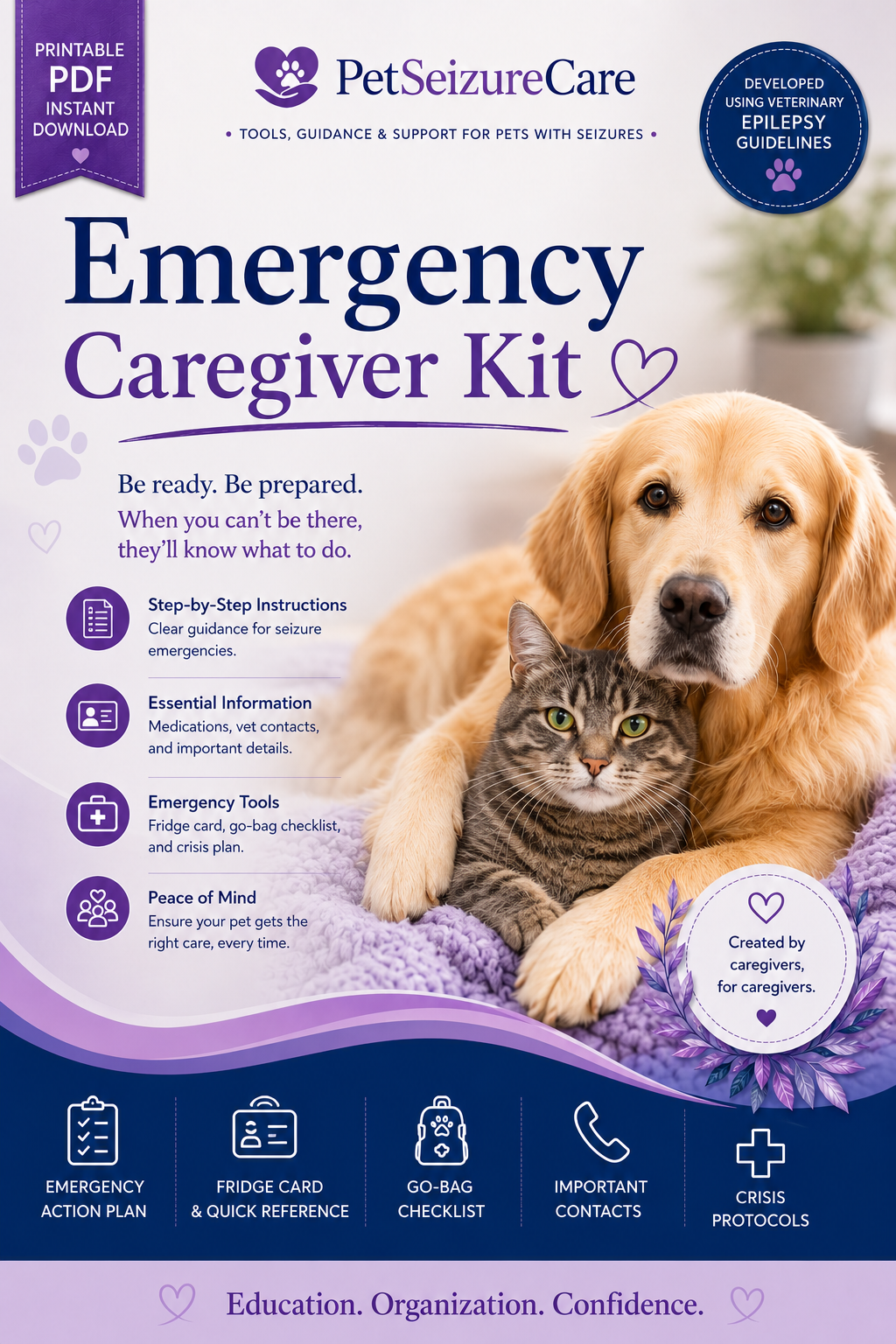
When a seizure happens, you shouldn't have to think — you should be able to follow a plan. The Emergency Caregiver Kit gives you a step-by-step action plan, a fridge card, a go-bag checklist, and a calm FAQ to share with anyone who cares for your pet.
Explore the Emergency Caregiver Kit →- American College of Veterinary Internal Medicine. (2015). ACVIM consensus statement on seizure management in dogs. Journal of Veterinary Internal Medicine.
- International Veterinary Epilepsy Task Force. (2015). Proposed diagnostic approach and classification of epilepsy in dogs. BMC Veterinary Research.
- Merck Veterinary Manual. (2024). Epilepsy and seizures in small animals. merckvetmanual.com
- Royal Veterinary College VetCompass Programme. (2022). Epidemiology of canine epilepsy in primary-care veterinary practice.
- Platt, S. R., & Olby, N. J. (2014). BSAVA manual of canine and feline neurology (4th ed.). British Small Animal Veterinary Association.