

Guide 22 → Talking to Children About a Pet's Epilepsy
Talking to children about a pet's epilepsy
Children often witness seizures and are deeply affected by a pet's illness. Research on how children process pet illness — and practical guidance for honest, age-appropriate conversations.
What you need to know
Children are often present during seizures — and their reactions range from terror to confusion to remarkable resilience. How families talk to children about a pet's epilepsy matters: it shapes how children process what they witness, whether they feel safe to ask questions, and how they understand illness, vulnerability, and care.
This guide draws on research about children and pet illness to offer practical, honest approaches for families navigating epilepsy with children at home.
What children typically experience
Available research on children and companion animal illness suggests that children form deep bonds with family pets and are significantly affected by pet illness and death. Children who witness a seizure without preparation often experience acute fear — they may believe the pet is dying. Without honest explanation, children may develop anxieties that become harder to address later.
Age shapes how children understand and process illness:
- Under 5 — Understand very concrete descriptions; focus on reassurance that the pet is okay and that seizures, while scary, are not always dangerous
- 5–8 — Beginning to understand cause and effect; can understand that the pet has a condition in their brain that sometimes causes shaking, and that medicine helps
- 8–12 — Can handle more nuanced explanations; may ask directly whether the pet will die or get worse
- Teenagers — Can engage with complete information; may have strong emotional responses and benefit from being included in care discussions
Practical conversation approaches
Be honest — children can handle more than we often expect
Well-intentioned reassurances that aren't fully truthful ("the pet is just sleeping," "everything is fine") can undermine trust when children observe that something is clearly not right. Honest, age-appropriate language builds trust and gives children accurate frameworks for what they're seeing.
Use concrete, simple language
"Buddy has epilepsy. That means sometimes his brain sends the wrong signals and his body shakes. It looks scary but usually he doesn't feel it, and afterwards he gets back to normal. The medicine helps make it happen less often."
Give children a role
Children often feel helpless watching a seizure. Giving them a specific, safe role reduces panic and provides agency: "If Buddy has a seizure, your job is to come find me and tell me right away." Older children can learn basic seizure response steps — don't restrain, don't put anything near the mouth, time the seizure if possible.
Acknowledge their fear as normal
"It makes sense that it scared you. It scares me a little too. But we know what to do, and the vet is helping us keep Buddy as safe as possible."
Managing ongoing anxiety
Some children develop persistent anxiety about the pet seizing — particularly around being alone with the pet or going to school and leaving the pet home. A visible family seizure response plan ("if Max has a seizure, here is what to do") can reduce hypervigilance by giving children a concrete framework rather than a formless fear.
When the pet's condition worsens
Children who have been given honest, age-appropriate information throughout the pet's illness are better prepared to process difficult news about worsening condition or end-of-life decisions. Avoiding these conversations in an attempt to protect children typically makes the eventual grief harder to process, not easier.
If a child is showing persistent anxiety, sleep disruption, or significant behavioral changes related to the pet's illness, it may be worth a conversation with their pediatrician or school counselor. Pet illness can be a significant stressor for children, and professional support is both available and appropriate.
- Children are significantly affected by witnessing seizures — honest, age-appropriate explanation reduces fear and builds trust
- Children can generally handle more honest information than adults expect, when presented appropriately for their age
- Giving children a specific safe role during seizures reduces panic and builds confidence
- A visible family seizure response plan reduces ongoing anxiety by providing concrete guidance
- Children who receive honest information throughout a pet's illness cope better with difficult news later
- Persistent anxiety or behavioral changes in a child warrant a conversation with their pediatrician or counselor
- Kaufman KR, Kaufman ND. And then the dog died. Developmental Medicine & Child Neurology. 2006;48(11):927–930. doi.org/10.1017/S0012162206002040
- Nettifee JA, Munana KR, Griffith EH. Evaluation of the impacts of epilepsy in dogs on their caregivers. Journal of the American Animal Hospital Association. 2017;53(3):143–149. doi.org/10.5326/JAAHA-MS-6537
- Triebenbacher SL. The companion animal within the family system. In: Wilson CC, Turner DC, eds. Companion Animals in Human Health. Sage Publications; 1998.
Last reviewed: May 2026. This guide is informed by current veterinary neurology literature and is for educational purposes only. It is not a substitute for advice from your veterinarian.
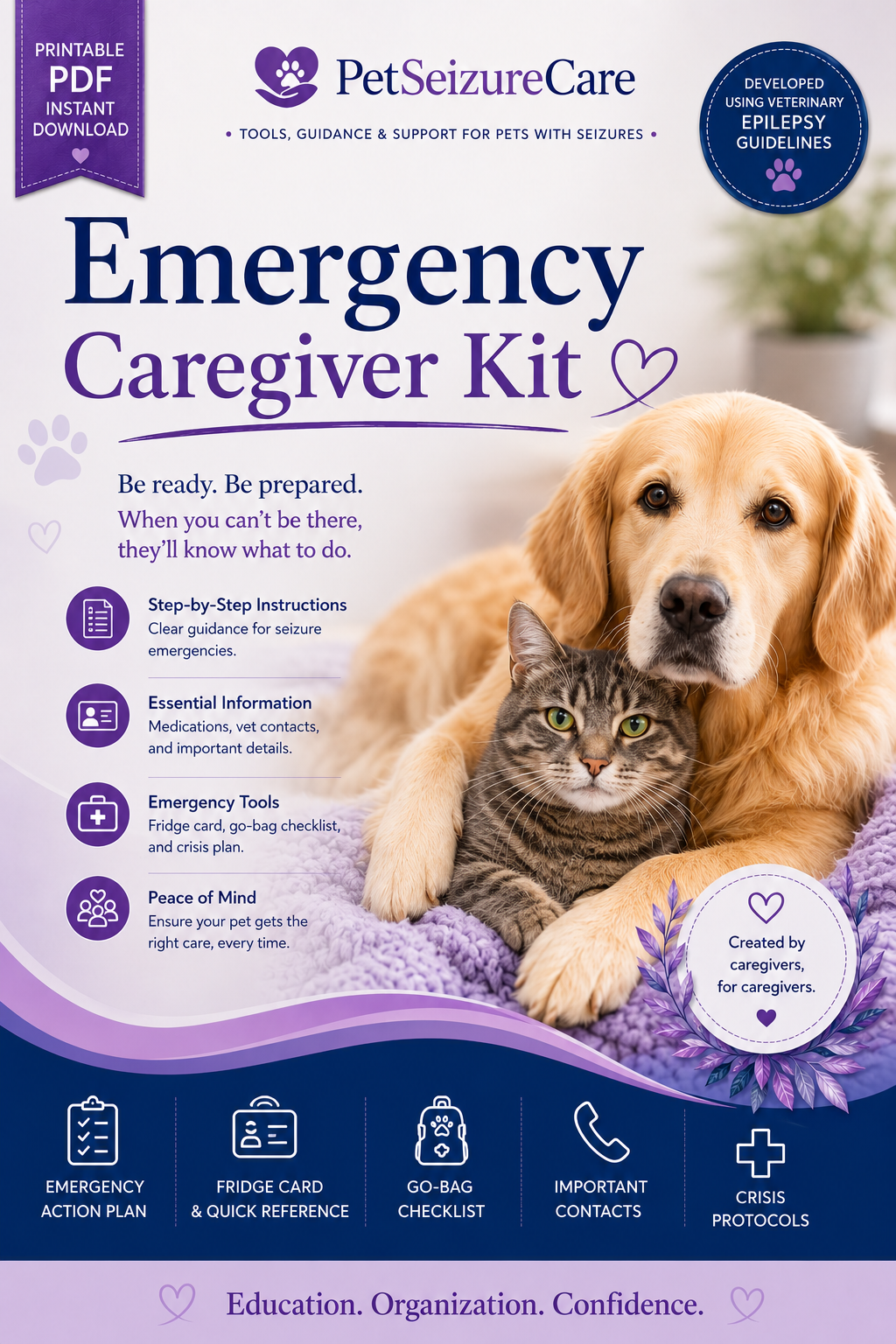
A plan the whole family can follow
Give everyone — including the kids — a clear plan.
This guide recommends a visible family seizure response plan. The Emergency Caregiver Kit is exactly that: a fridge card and step-by-step handbook the whole household can read and follow, so children and adults alike know what to do — and feel less afraid because they're prepared.
Explore the Emergency Caregiver Kit →Help advance pet seizure research
Your tracking data could contribute to better outcomes for every pet with epilepsy.